Original Article: https://mp.weixin.qq.com/s/MWWCaY9-AmzY8YxlshBGEg
Original Author: VOGUE
This article was originally published on 22 September 2026 on VOGUE’s Weixin Official Account .
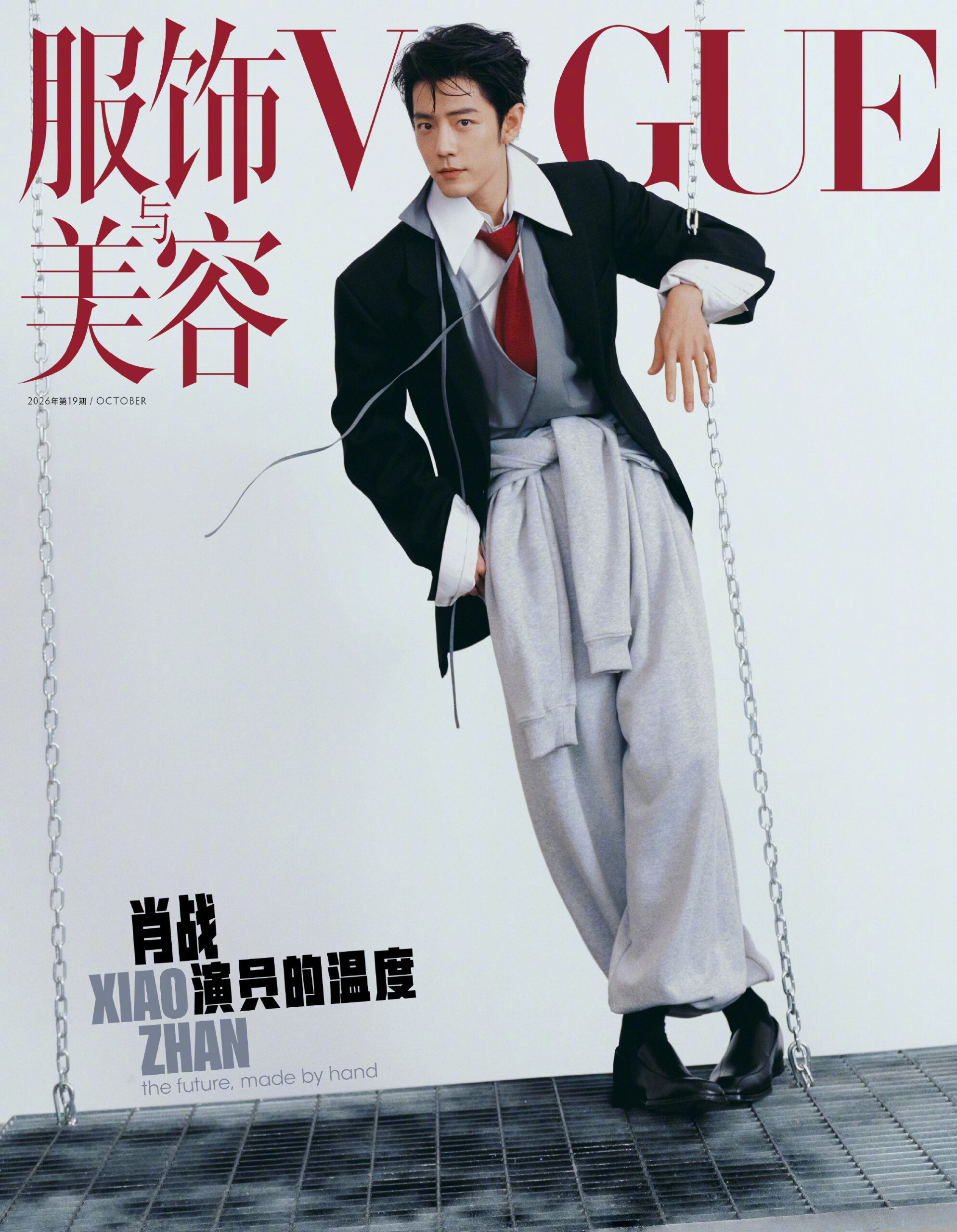
If life is similar to traversing mountains, the scenery, whether distinct or veiled, is woven into the very fabric of everyday moments. Whether acting, singing, or devoting himself to his passions, Xiao Zhan does not deliberately chase specific outcomes. Instead, he quietly focuses on the task at hand, allowing unexpected transformations to naturally reveal his true self.

Seeing Xiao Zhan again after three years, there is no distinct difference. He remained soft-spoken, he stretched his limbs during in the brief intervals while the photographer made preparations, gazing at the images on the monitor, mentally rehearsing the expressions and poses he would intend to present next. Yet, upon closer inspection, one could spot subtle clues: the clearly defined lines of his shoulders and arms revealed during the shoot, and the faded calluses across his knuckles. Time might be silent, but it left its mark. Xiao Zhan was quick to notice this detail. Having been interviewed frequently, he would often try his best to provide different answers, formulating his thoughts while speaking, his words always carried a fresh touch.

Anticipate Uncertainty, Allow Frayed Edges to Appear
Xiao Zhan dreams whenever he is filming. Last April, while shooting the TV series “The Infinite 10 Days” in Qingdao, he frequently dreamt of a room measuring approximately 15 square meters.


At first, Xiao Zhan was mentally prepared. After several consecutive days of filming, however, he began to reflect on the experience. “The Infinite 10 Days” iss built around a strong “time loop” premise, with much of the action taking place within a single room. “We filmed day after day, so intensely that I lost myself and all sense of time; even in my dreams, I was trapped in that room,” he recalled. “I wasn’t Xiao Zhan the actor, instead I was a genuine inhabitant of that room, engaged in actions integral to the story. For half a month straight, I dreamt about it every night.”
According to common wisdom, dreams are a displacement of stress and a projection of obsessions, often reflecting what occupies our thoughts during the day. In the released 31-second teaser, Xiao Zhan delivers just one line: “My name is Qi Xia, and I am about to start lying.” Portraying a character who straddled the line between good and evil proved challenging for him at times. “He lives within his own web of lies, yet he had to simultaneously carry out assigned tasks, it felt like a game within a game,” he explained. “Given this setup, the character is restless and guarded, prone to habitual suspicion.”



During the script reading, Xiao Zhan noticed that the lines of the other characters clearly highlighted their distinct personalities: ranging from the outgoing and the larger-than-life to the talkative, the timid, and the calculative. Qi Xia, however, was far too steady, a constant observer throughout. In real life, such a person might simply be described as “dull”.


Where was the key to the performance? Xiao Zhan tried to find it from Qi Xia’s speech patterns and demeanor, and consulting with director Xu Hongyu, using the naturalistic, slice-of-life narrative style and the “infinite loop” genre to find the balance. A role like this could easily become a caricature if not handled with precision. He worked at it within the tight constraints of the role, seeking the details in the limited performance space and collaborating with the crew; for scenes where he was unsure, he would check the monitor and discuss adjustments with the director. However, he did not rely on the monitor. He frankly admitted that he would check the monitors much less frequently now than he used to. On set, actors would not see the live feed, whereas the monitors revealed the finished look, just like seeing the answer to a problem before solving it, the experience is completely different. “I look forward to the appearance of the unexpected,” Xiao Zhan expresses. “It’s good to let some frayed edges appear, to have those unforeseen moments surface in the performance.”
Stories Beyond the Script
The last time Xiao Zhan encountered that frayed edge was last October in Jinzhou, the filming location for the TV series “A Small Town Remedy”. He had visited the Northeast briefly for work prior to that, staying for just two days. In Jinzhou, during the transition from autumn to winter, the air was crisp and clean, occasionally carrying a faint scent of burning. Yet, three months after leaving, he found himself frequently missing that cold air tinged with a hint of charred scent. Having grown up in Chongqing, Xiao Zhan had no personal roots in the Northeast; it was the character Liu Zhengliang that unexpectedly stirred within him this nostalgia, a feeling difficult to put into words.

In fact, the journey to starring in “A Small Town Remedy” came about somewhat by chance. Through an opportune coincidence, Xiao Zhan received the scripts for the first five episodes. “I started reading,” he said, enunciating slowly, “and simply couldn’t stop.” After finishing those episodes, he immediately asked where the rest of the script was. He had a similar feeling when reading the script for “Legend of Zang Hai”, it was like being back in school, eagerly following a serialized novel and experiencing a rollercoaster of laughter and tears. He decided right then and there to vie for the role of Liu Zhengliang. Liu Zhengliang was a promising young doctor whose career hits a disastrous setback following a medical mishap; forced to return to his hometown, a small city in Northeast China, he continued practicing medicine at a local grassroots hospital. Together with those around him, he healed others while finding his own path to healing, weaving many heartwarming stories.


Although he portrayed a doctor, Xiao Zhan placed on the emotional aspects of the role before the professional ones. He was deeply impressed by the characters’ individual growth and the way they healed one another. Before filming began, his initial preparation was not about acquiring medical expertise, but rather about immersing his senses in Northeast China. He sought out films and TV series that captured the region’s unique character, studying the nuances of human relationships and social dynamics portrayed within them. Even though Liu Zhengliang had moved to Shenzhen with his uncle at a young age, his fundamental identity as a Northeasterner remained unchanged. After discussing the role with director Zhang Xiaobo, Xiao Zhan formed a clear vision: from his appearance to his inner world, Liu Zhengliang needed to be seamlessly integrated with the people, places, and culture of the Northeast.
Some commentaries have framed Liu Zhengliang’s remarkable journey as a story of an ordinary person facing setbacks and finding rebirth. Xiao Zhan, however, dismisses this framing without hesitation: whether a character is an ordinary person or not is by no means his criterion for accepting a role. Beyond the story of Liu Zhengliang’s life after returning to his hometown, Xiao Zhan cares more about the story beyond the script: a promising young doctor who held a respectable job in Shenzhen but endured an adolescence devoid of familial affection. What happened to him over those years? What transformed him into someone with an impenetrable wall around himself, emotionally detached and socially withdrawn? Was he ostracized during his school days? In moments of helplessness, how did he repeatedly fortify his defenses to become the person the audience sees on screen? “It was precisely these elements that drew me in,” Xiao Zhan admitted. “Whether a character exudes instant charm or is cast as a hero, none of that is the primary factor in my decision.”


This process of finding a connection began with the film “Gezhi Town”. On set, Xiao Zhan and director Kong Sheng spent a great deal of time discussing what Mo Dexian had experienced beyond what was explicitly written in the script. There was a scene where Mo Dexian and his wife, Xia Cheng, would argue over their child’s deafness. Initially, Xiao Zhan and his co-star played out an externalized version of the scene. “I felt Dexian should try to cheer his wife up, so I played it in a more lighthearted, amusing way. My co-star’s immediate reaction was one of sadness, she felt that approach wasn’t right,” Xiao Zhan explained.



They had already completed that scene. Yet, half a month later, Director Kong Sheng approached them, suggesting they shoot it again. “Let’s do it again” was one of Xiao Zhan’s favorite phrases on set, coupled with his own lingering uncertainty about the previous take, both he and his scene partner readily agreed. Director Kong didn’t dictate exactly how to act it out; he offered just one pointer: the child had been deaf for some time, and the couple had argued about it if not a hundred times, then at least fifty times. This was their daily reality; they might well start quarreling the moment they opened their eyes. Given the frequency of these fights, would the emotions still be so explosive during any of the fights? “It clicked for me instantly. I had been playing the result, but what about the process? What had the character gone through beyond the script, in the moments unseen by the audience? These are things an actor has to think through. That experience left a really, really profound impression on me.” Xiao Zhan repeated the word “really” twice, even emphasizing it.

Faced with a sudden, devastating blow, the human instinct is to flee. Xia Cheng uses words that sound like a joke to sidestep the reality of her son’s deafness, she feels there is no point in dwelling on the unchangeable past, it is better to look ahead. Rather than engaging in explosive conflict, most people in real life react this way, this was what lies beyond the written script. Xiao Zhan grasped this, and the version of the performance he arrived at, after fully internalizing the character, was the one ultimately used in the final cut. “As I acted, my connection to the character deepened, my thoughts became more comprehensive, and the resonance grew stronger. I do my homework before filming begins, but that tends to be somewhat fragmented. To complete it requires going through a process.”

“I have always been living a tangible life”
Acting is a process, and so is life.
Xiao Zhan compares the relationship between himself and his character to looking in a mirror. He often draws upon his own past experiences, putting himself in the character’s shoes to reflect: in what ways does the character handle things better than he does? At what moments is the character stronger? Beyond the comparison, there are also parallels to be drawn. Liu Zhengliang had been away from his hometown for too long; his return to the Northeast as an adult would be somewhat reminiscent of Eilis, the protagonist of the novel “Brooklyn”, who was an outsider in New York and yet found her native Irish town strangely unfamiliar when she returned.

Xiao Zhan is different, he has a close bond with Chongqing, and the two “meet up” from time to time. In June 2024, he took a stroll through the old streets and the Jiefangbei area, and even revisited the place where he had once interned. He returned a few more times after that and was surprised to discover a new bridge spanning the river. “I asked a friend when it was built and where it led,” Xiao Zhan said. “I hadn’t been back for a year, and a bridge had sprung up out of nowhere!” He found it surreal, no matter how long he had been away, the moment his feet touched his native soil and he heard the familiar local dialect, he felt a sense of peace.



A sense of ease also began to emerge in his daily life. Xiao Zhan started frequently speaking about the importance of life itself. Two years ago, he traveled abroad with his parents and shared a family photo on social media. It was a shot taken from behind. In a later interview, he noted that the trip had confirmed one thing for him: “I am right here, living a real, tangible life.” Reflecting on it now, however, Xiao Zhan wants to refine that sentiment: “Looking back, I’ve always been living a tangible life. No one can ever truly step outside of life. At the time, perhaps it was the experience of sharing the outside world with my loved ones, that sense of happiness gave me a feeling of steadiness and peace.”



Time never skimps on its magic for those who are honest with themselves. Back in 2023, Xiao Zhan once remarked: “There is another Xiao Zhan, a Xiao Zhan in quotation marks, though he might no longer be me. We all work for him, myself included.” Bringing this up, Xiao Zhan smiled. “At the time, I hadn’t quite learned how to get along with myself. If you were to ask me that question now, I wouldn’t put it that way, my mindset and state of being have shifted.” He paused thoughtfully for a few seconds before continuing, “The Xiao Zhan people see in dramas and movies, the one on billboards, and the one encountered in real life, they are all me. There is no need to draw such absolute lines, as if there were two or three versions of me. Perhaps if we discuss this topic again in two or three years, I’ll have a different perspective.”

Two or three years is a short time, gone within the blink of an eye. Yet, it is also a long time, offering space for the changing mindscapes. If life is similar to traversing mountains, the scenery, whether distinct or veiled, is woven into the very fabric of everyday moments. Xiao Zhan’s daily life exists in the gaps of a heavy workload. He stays committed to his fitness routine and carves out time to watch the thriller movies he enjoys, such as recent hits like “Obsession” and “Backrooms”. After wrapping up on set, he would slip into a cinema to watch “Dear You”. A good story, a fine performance, with emotion and humanity, resonates deeply regardless of the context. He sings, and he also listens to music. An actor portrays others, the sentiments expressed in songs are closer to Xiao Zhan the person.

In August of this year, Xiao Zhan appeared as a guest at Na Ying’s concert in Beijing. The tour bore a touching title: “I Am Here Because You Are Here.” During the song “Echo”, Na Ying choked up with emotion as she sang the lines: “You will not doubt yourself, when you are already good enough, and you are always free to let go.” At that moment, Xiao Zhan was standing on a lift platform equipped with a monitor that allowed backstage crew to track the action on stage in real time. Seeing Na Ying in tears moved him deeply, as he was well aware of the backstory. “Na-jie put in a tremendous amount of preparation that the audience never saw, weighted burpees, lunges, barbell squats, the intensity of her weighted training was on par with my own,” Xiao Zhan recalled vividly. “In that moment, I was so happy for her, truly delighted on her behalf. It was the moment that moved me the most recently.”

When listening to music in private, Xiao Zhan follows his mood, with a wide range of genres. He does not seek out obscure tracks, instead, he is captivated by many classic hits and older songs. He recently stumbled upon Ayal Komod’s “Breeze Perfume”. Released in 2002, this love song features simple lyrics and a gentle melody, which Xiao Zhan liked very much. One passage goes: “That night, we rode the breeze, your arms held me close as we slowly enjoyed perfume-like tenderness, and time stood still.” Of course, time does not actually stand still, the sensation of it “standing still” is because the effort invested and the emotions poured into the moment crystallize that instant into eternity. Xiao Zhan understands this deeply.
Looking back to when he first entered the acting profession ten years ago, Xiao Zhan found acting incredibly difficult and even questioned whether he was suitable to continue the path. As time went by, however, each day seemed to reaffirm that persevering was the right choice, that those long stretches and fleeting moments of struggle were all part of his growth. As for his future as an actor, Xiao Zhan said he looks forward to the opportunity to immerse himself in compelling works and memorable roles. “Really.” He paused, then emphasized it once more: “Really.”